
I found it by ignoring Google Maps.
After 10 minutes of driving in the wrong direction through little roads with overgrowth at the base of Mount Haguro, I gave up on my phone and started following the signs instead. That decision; trusting hand-painted wood over an algorithm; felt oddly appropriate for a place that has been guiding pilgrims for over 1,400 years.
A Dewa Sanzan temple stay is one of those experiences guidebooks underplay and Instagram can’t capture. Three sacred mountains in northern Japan; a lodge run by mountain monks; one of the strangest, most disorienting nights I’ve had on the road.
Dewa Sanzan is one of Japan’s most sacred sites, and one of its least visited by foreigners. Three mountains; Haguro, Gassan, and Yudono, deep in Yamagata Prefecture in the Tohoku region of northern Honshu. For centuries, Yamabushi mountain monks have trained, chanted, and kept the flame of Shugendo alive here. Their beliefs are a philosophy woven from Shinto, Buddhism, and a raw reverence for nature. Most travellers never make it this far north. That’s exactly why I came.
What Is a Dewa Sanzan Temple Stay (Shukubo)?
A Dewa Sanzan temple stay isn’t a hotel. It isn’t quite a temple either. A shukubo exists somewhere between the two; a pilgrim lodge run by Yamabushi monks, built to shelter those making their spiritual journey through the mountains. The rooms are tatami. You sleep on a futon on the floor. The walls are thin wood. The silence is thick. In winter or spring/autumn they have a little gas heater which was very helpful.

The Food — Shojin Ryori
Dinner arrived as a ritual in itself. Shojin ryori, the ascetic cuisine of the Yamabushi, is vegetarian, intricate, and rooted in the mountains around you. Mountain vegetables harvested by hand, prepared using techniques passed down through generations, served in small lacquered dishes that together form something more like an offering than a meal.
It is quiet food. Food that asks you to pay attention. I ate slowly and thought about very little, which felt like the point. I enjoyed dinner, every bite was a surprise in texture and flavour.

The Night — Honest
I had read all of this before arriving. What I hadn’t read was how disorienting it would be to navigate alone once night fell.

The storm arrived after dark. I lay on my futon listening to the building creak and groan around me, not entirely sure I understood its structure, which corridors led where, which doors opened to outside. I was alone in the building. The wind was loud. The darkness was complete in a way city people forget darkness can be.
I won’t pretend that hearing the building screech like an old wooden ghost ship wasn’t unsettling, it was, and it was hard to fall asleep. My mind was racing and there was something underneath the fear, a kind of aliveness that comes from being genuinely out of your comfort zone. No Instagram, no noise, no familiar reference points. Just you, a storm, and 1,400 years of mountain spirits for company. I fell asleep once the sun came up.. to shortly after hear my alarm for the morning prayer.
The Morning Ceremony — 7am Sharp
I nearly missed it due to my bad sleep, and slightly because of the owner and me being lost in translation.
The ceremony was at 7am inside the temple. I was at the entrance at 7am in my yukata, assuming that was close enough. It was not, and the owner told me a yukata is not the right temple attire. I changed as fast as I could and ran through the ancient halls
I silently shuffled inside, and I arrived breathless into a space already alive with conch shell horns, a sound that vibrates somewhere below thought. The morning light came through the temple at an angle that felt almost staged, but wasn’t. The monks handed me an English pamphlet, which I held but barely read. The ceremony needed no translation. It was powerful in the way that very old things are powerful, not because of spectacle, but because of weight.
Standing there, slightly out of breath, slightly underdressed, I felt genuinely moved. Not in a way I could explain easily. In a way I could only photograph and hope the image carried some of it forward.
After the ceremony, I went back to the shukobo and I enjoyed the Breakfast. It was similar to the night before, albeit a little more simple, but deliberate, nourishing in a way that went beyond calories.

The Hike — 2,446 Steps and a fly Problem
I arrived at Dewa Sanzan too late in the day to make the summit. The mountain doesn’t wait for bad timing, so I spent the night in the shukubo and set off the next morning after the morning prayer.
The path up Mount Haguro is 2,446 stone steps, climbing through a forest of ancient cedar trees so tall they make you feel genuinely small. The air is cool and damp even in the warmer months. The cedars muffle the outside world completely.

Halfway up, a small teahouse appears like a reward you hadn’t expected — I stopped, caught my breath, and ordered mochi. It arrived soft and sweet, the kind of simple thing that tastes extraordinary after effort.

Then the flies discovered me.
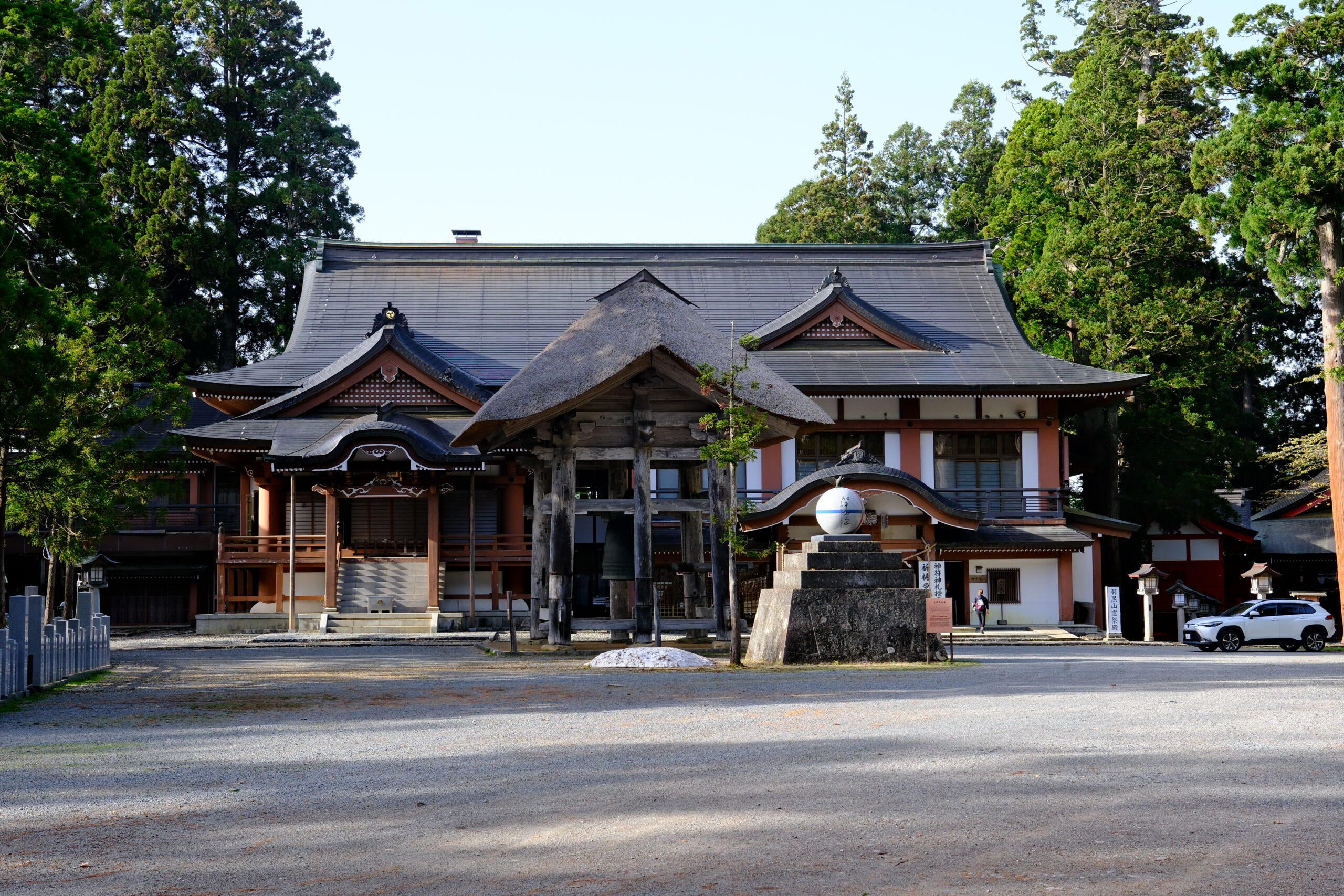
I ate faster than I intended and moved on quickly, which is perhaps the most human thing that has ever happened on a 1,400-year-old pilgrimage route. At the top, the main shrine complex, Sanzan Gosaiden, opens up with a scale and presence that stops you mid-step. The thatch roof is the thickest of any building in Japan. Standing in front of it, slightly out of breath, slightly fly-rattled, it hits you that this structure has been here through centuries of storms, winters, and pilgrims just like you passing through and moving on.
It is the kind of place that makes the journey to get there feel necessary.
Practical Guide
Getting there: Take the Shinkansen to Tsuruoka Station, then a bus to Mount Haguro. Allow more time than you think. Public transport is infrequent; a rental car helps significantly, that’s also how I got there
Finding your shukubo: Follow the wooden signs, not Google Maps. Trust the mountain.
Booking your Dewa Sanzan temple stay: Reserve well in advance. Some shukubo have limited English; Saikan lodge near the summit is the most accessible for international visitors.
What to bring: Warm layers, respect for silence, and an early alarm.
Season: Mount Haguro is accessible year-round. Gassan and Yudono open July to mid-October.
Cost: Expect around ¥10,000–¥15,000 per night including dinner and breakfast.
Should You Go?
Only if you want something real.
Dewa Sanzan is not comfortable, not convenient, and not on the itinerary of most Japan travel guides. The shukubo will disorient you. The storm may keep you awake. You might get lost on the way there.
Go anyway. The world has more to offer than your feed suggests, and Dewa Sanzan is proof.
Have you stayed in a shukubo or explored Tohoku off the beaten path? I’d love to hear your story, drop a message or find me on Instagram..