
In 2018 the Khiva old town was a place you could still have almost entirely to yourself, and I did. Getting there was the hard part. When I was there, there was no smooth way into Khiva, and I had agreed to meet my dad in Khiva, and the only sensible option was hiring a driver, which also seemed the most reliable. Then he turned up in a different car than the day before, a classic Lada. I had my doubts about it, but I got in anyway.
Halfway across the Kyzylkum, at a desert police checkpoint, the car died. Standing there in the heat, roughly 200 kilometers of empty desert still between me and Khiva, I was not sure I would arrive at all.
I am telling you the year up front for a reason. Uzbekistan has changed a lot since then. There is a train now, the road has improved, and the empty streets I found are filling up. What has not changed is the desert, the walls, and what it feels like to almost not make it somewhere.
Quick Facts
- The old town: the Itchan Kala, a fully walled inner city, UNESCO World Heritage since 1990
- From Bukhara: around 450 km across the Kyzylkum desert, 6 to 7 hours by road or around 6 hours by direct train
- Our version: by road in 2018, one breakdown at a desert police checkpoint, arrival at ten at night
- Season: April to June and September to October are the comfortable windows, midsummer regularly passes 40 degrees
- Entry: one combined ticket at the gate covers most monuments inside the Itchan Kala, no permits needed
- Nearest airports: Urgench, about 30 minutes away, and Nukus
Bukhara to Khiva by road: what I signed up for
It had looked simple on paper. One long drive west from Bukhara, through the Kyzylkum, arrive in Khiva by late afternoon. The Kyzylkum is not a postcard desert. It is flat, dusty, endless scrub in every direction, and back then the road matched it. Long stretches of broken asphalt where the car spent more time avoiding the road than driving on it.
For hours nothing happens out there. Then everything happens at once.
The checkpoint in the Kyzylkum
The Lada gave up at the checkpoint. Not a warning light. Properly broken, in a place where the nearest anything was hours away in either direction.
What happened next is the reason I keep going back to Central Asia. The policemen came out and got involved, all of them, and the car was fixed within the hour. No garage, no tow truck, no certainty. Just people who decided the problem was solvable and started solving it, for a stranger they would never see again.
I made it. Slowly, and long after dark.
Khiva at ten at night
I arrived at the Itchan Kala, the walled inner city, at around ten. If you ever get the choice, arrive in Khiva in the dark. The mud brick walls glow under the lights, the streets are silent, and the whole city looks like it was built the day before and abandoned a thousand years ago at the same time. After the day I had, it did not feel real. At the hotel my dad was waiting for me. He had flown in from the Netherlands with a layover, and we both had adventures to tell.
The Khiva old town to ourselves
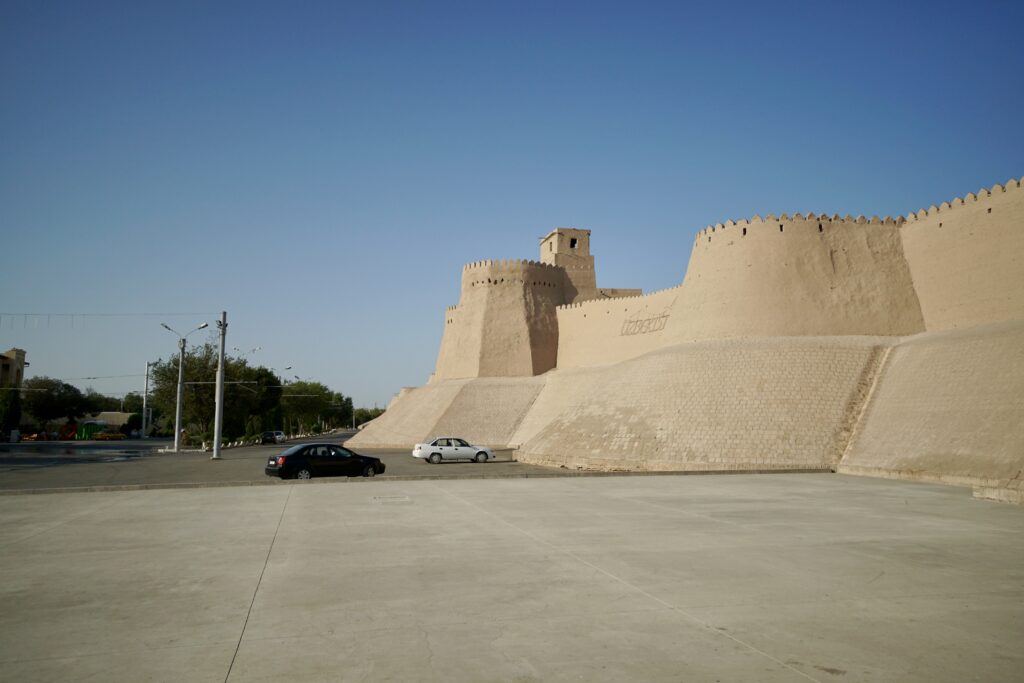
The next morning confirmed it. In 2018 Khiva was quiet in a way that is hard to describe now. We walked toward the inner city and its walls rose up ahead of us, majestic. I knew Khiva would be a beautiful old town, but seeing that it is still a true fort was impressive. We walked in, and the streets were empty with a special old vibe, like the city had kept its own time.
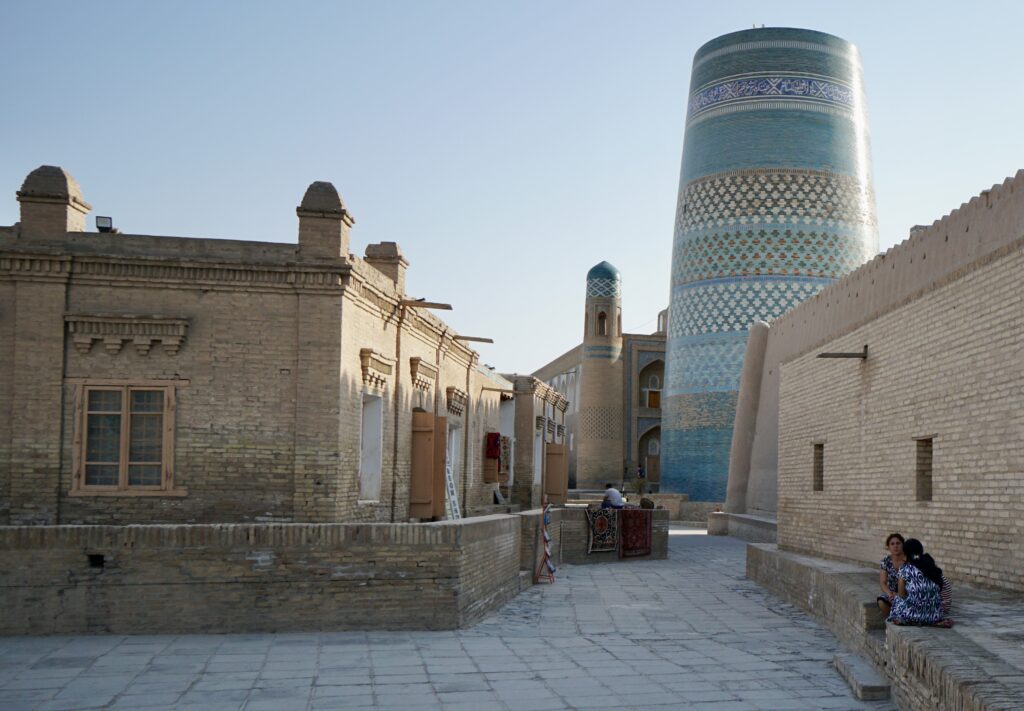
Shortly after we entered, we saw the Kalta Minor, the fat unfinished minaret wrapped in turquoise tiles that is on every photo of Khiva ever taken. It deserves the attention. I loved the striking contrast between the blue tiles and the sand coloured stone. It may be the most photographed thing in Khiva, and standing in front of it I understood why.
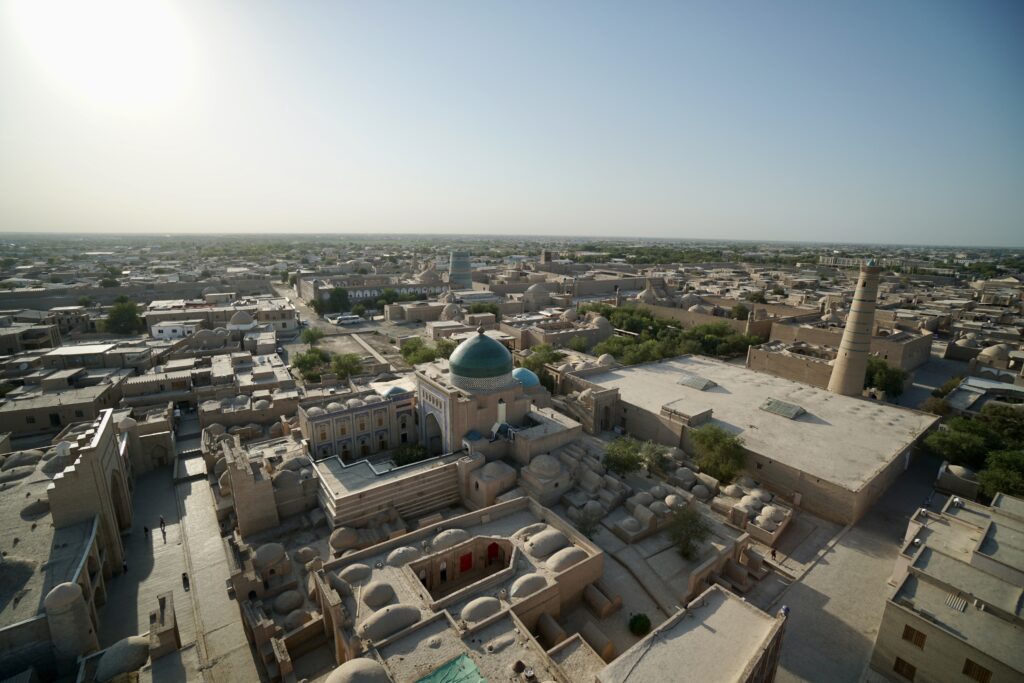
Afterwards we just strolled through the town, finding quiet nooks and little scenes between the local people. It was like living in a museum. At some point we ended up at the Khoja Minaret, the tallest minaret in Uzbekistan and the only one you could climb at the time. It is relatively young, built around 1908, and even though I love the older stuff, the view over Khiva from the top was super great. Go up if your legs allow it.
The mysterious saint
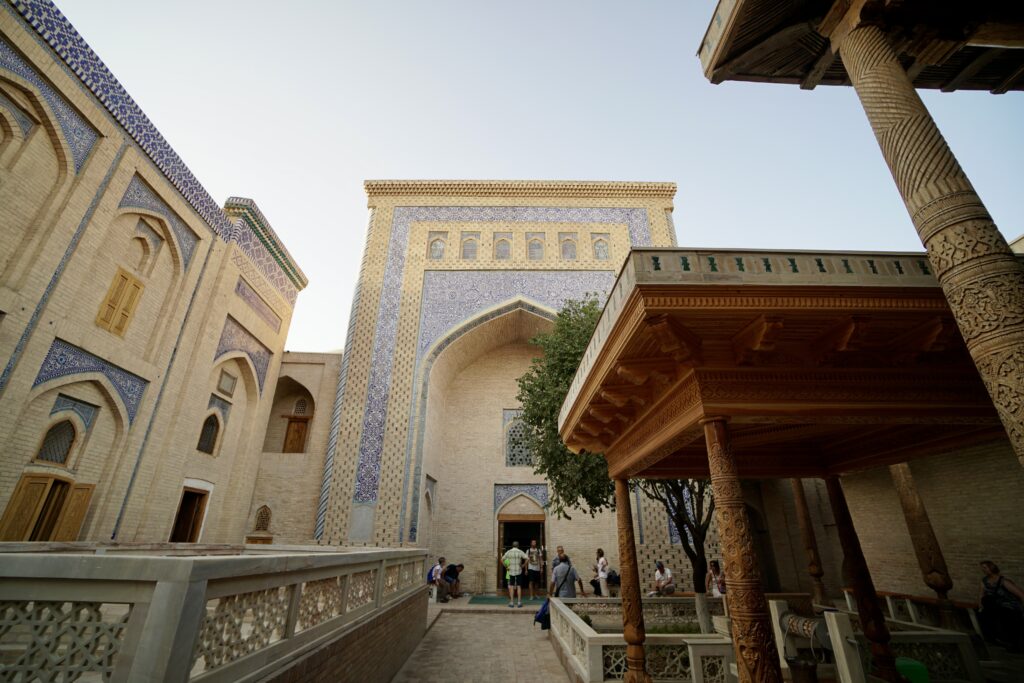
We came down impressed, with two more places to see that day. The first was the Pahlavon Mahmud Mausoleum, the resting place of Khiva’s patron saint and the most sacred site in the city. He was a poet, a saint and a wrestler, and I would have loved to meet the man. You enter through a courtyard with a well, and inside the ceiling is covered in blue tilework, quiet and cool while the sun does its work on the streets. Locals come to drink from that well. It was the busiest place we visited, and in the Khiva of 2018 that meant sharing it with a handful of pilgrims.
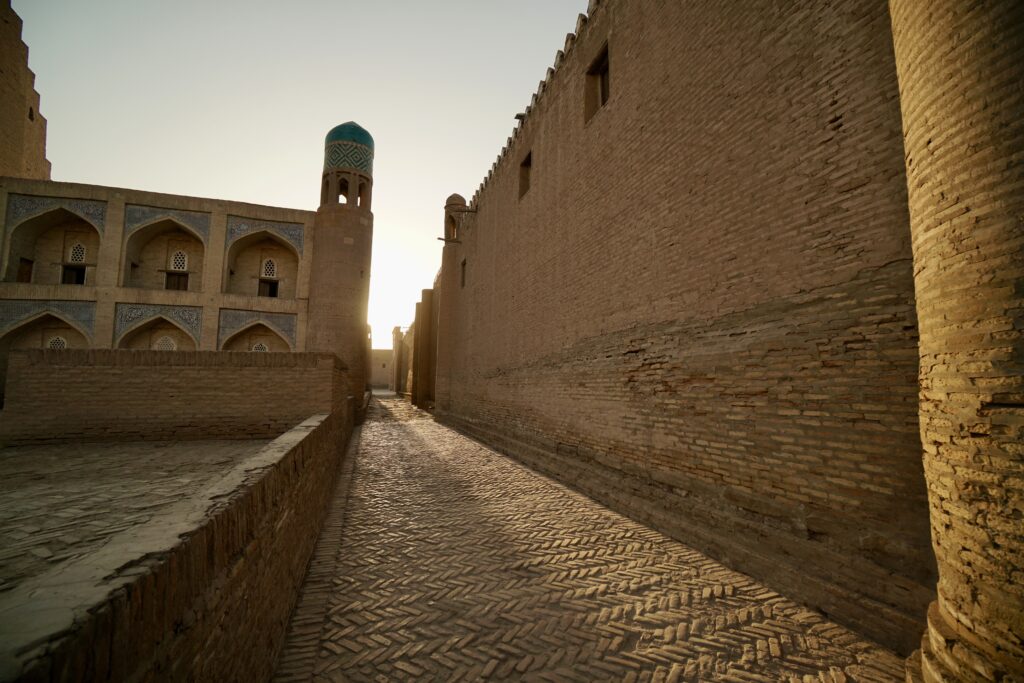
After the mausoleum the sun was starting to set. We walked through the old town and every street became its own artwork.
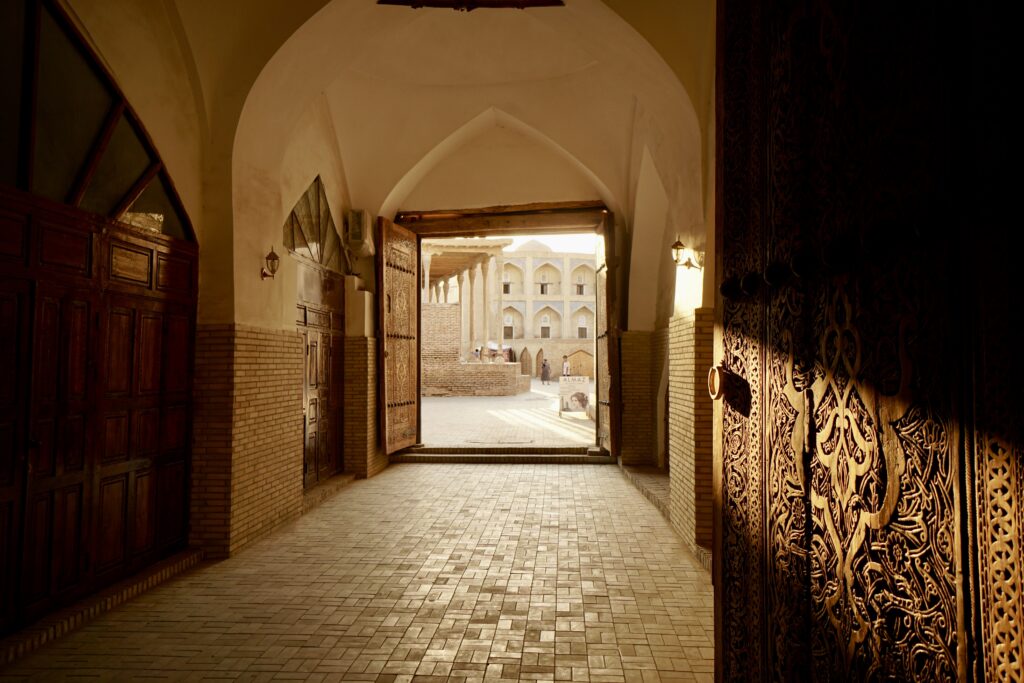
During golden hour I made one of my favourite pictures of the whole journey (below). A small covered alley, an open door framed in carved wood, the older city waiting behind it. As a Silk Road lover, this image says it all to me. Every door in Khiva is a portal to another story. This one became a limited edition print, and if you want this doorway on your wall, you can find it here.
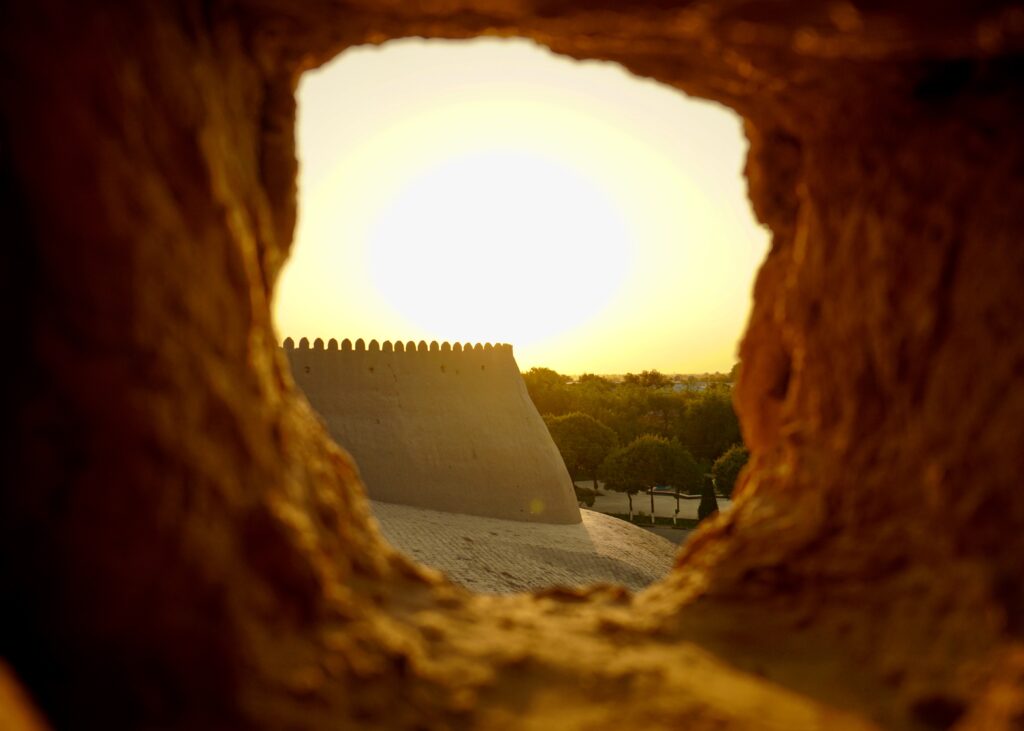
Last but not least, we still had to go up the fortress walls of the Kuhna Ark, the old stronghold of the khans. We were just in time. We loved walking along the ramparts and looking through the little peepholes as the desert turned orange and gold. Go up before sunset, I fully recommend it. We were, once again, completely alone up there.
Mr Green Tea
Having my dad there made the whole detour through the desert feel worth it twice over. Green tea arrives before you at every table in Uzbekistan, and he embraced it so completely that the staff at our hotel, the Zukhro Boutique Hotel, stopped using his name entirely. He checked in as my dad and checked out as Mr Green Tea. It still makes me smile.
The best thing we ate in all of Uzbekistan was the plov at Terrassa, a rooftop restaurant inside the walls with the Kalta Minor sitting right there in front of you. I ate plov across the whole country and nothing came close. Great food and so generous, and a view you would pay for even if the plates were empty.
Getting out through Nukus
Leaving was its own adventure. We flew out via Nukus, a Soviet era city further into the desert that felt like an old Russian ghost town, wide empty streets and a strange, heavy quiet. Nobody writes about Nukus and that is exactly why I will, in its own post, because it deserves more than a paragraph. The flight out somehow ended with us in Kyrgyzstan, which was amazing and honestly hard to believe. That is also a story for another day.
If you have read my Ala Kul story you already know how that chapter goes.
Know before you go
The short version: take the train unless you want a story.
- Stay inside the Itchan Kala walls if you can. We stayed at the Zukhro Boutique Hotel and arriving or walking at night is the closest you will get to the empty Khiva I found.
- Khiva is no longer quiet in the daytime. Day tours come through, so do your wandering early in the morning or after sunset.
- Golden hour is the best light for the old town, and the Kuhna Ark walls before closing are the spot for it.
- Flying out of Urgench or Nukus saves you repeating the desert in reverse.
Frequently Asked Questions
Around six to seven hours for roughly 450 kilometers, assuming nothing breaks. In 2018 the road was rough enough that our car did not survive it in one go. Conditions have improved since, but this is still a long desert drive with very little in between.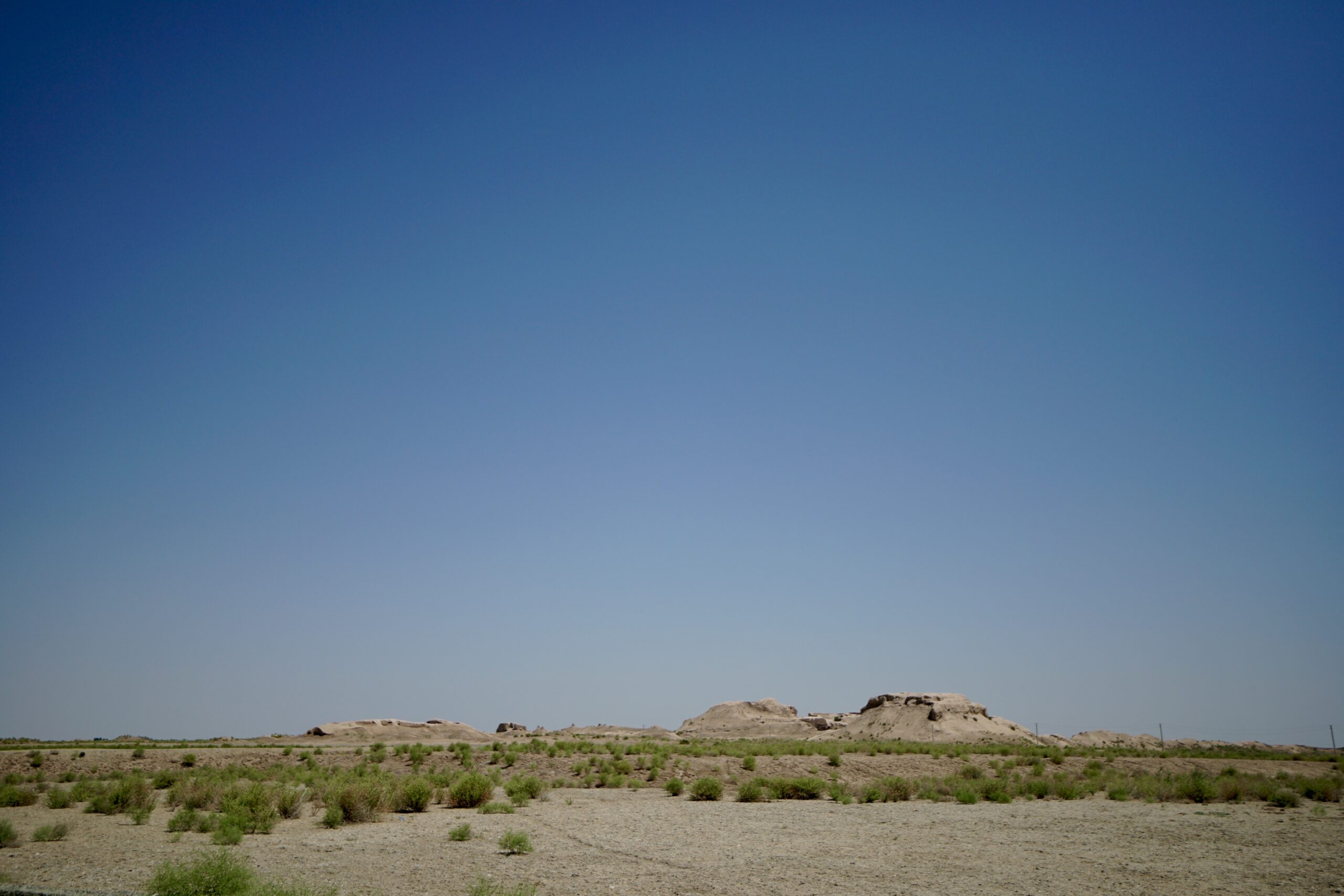
Yes. A direct daily train now runs in around six hours, and faster electric trains are being introduced on the route from 2026. For most travelers the train is the sensible choice.
Yes, and I would argue it is the most atmospheric of the three. Samarkand has the grandest monuments, Bukhara the liveliest old town, but Khiva is the only one that feels like a single complete city frozen inside its walls. Give it a night, not a day trip.
I never felt unsafe, even broken down at a checkpoint in the middle of the Kyzylkum. The risk is mechanical and logistical, not human. The people who fixed our car in the desert asked for nothing more than the job in front of them.
Terrassa, a rooftop inside the Itchan Kala with a direct view of the Kalta Minor. Order the plov. It was the best I ate anywhere in Uzbekistan, and that is a country that takes its plov seriously.
[…] have said this before about arriving in Khiva after dark, and it keeps being true. Turning up somewhere at night, slightly confused, lets your imagination […]