
In one week I fly to my hundredth country. With a number that round coming up, I keep going back over the experiences that stayed with me. First the gorillas in Rwanda. Then the climb to Ala Kul in Kyrgyzstan with my dad, still the sickest adventure I have had on foot. But the one I keep landing on is Varanasi, and that is what this story is about.
I am putting the dates up front the way I did with Khiva. 28 February and 1 March 2018.
Those dates matter more than I understood at the time. The alleys around the Kashi Vishwanath temple still stood when I walked them. The Uttar Pradesh state government had begun buying up the buildings in December 2017, fifteen months earlier, and yet I did not notice a single thing. No signs, no rubble, nobody mentioned it. Within about a year, crews knocked down 110 of those buildings, many of which had stood for centuries. By the end of 2021 the count reached roughly three hundred buildings and about five acres of the oldest continuously lived-in city on earth, cleared to open a stone corridor 400 metres long from the temple down to the river. I do not know exactly which of the streets I walked have disappeared. Some of them have. What follows is how Varanasi felt while those lanes were still standing.
Arriving, and going straight out on the water
My dad and I reached the city on the afternoon of 28 February 2018, and at first everything looked mundane. We had found a comfortable hotel on the outskirts, but neither of us wanted to sit in it. So we dropped our bags and went straight down to the Ganges for a boat.
By the time we got out on the water it was dark, and doing it in that order turned out to be the right accident. From the water you get the shape of the place before you are inside it. The ghats run along the bank in a line that seems endless, the buildings behind them go black against the sky, and the fires burn brighter than anything else in view.
I have said this before about arriving in Khiva after dark, and it keeps being true. Turning up somewhere at night, slightly confused, lets your imagination run ahead of the facts. Then the next morning puts the pieces back in the right order.
That is where I took the photograph. Manikarnika from the water, after dark, fires going, a lot happening in one frame, and enough distance between me and it that I was not standing over anybody’s funeral to get it. It is still my favourite frame from the whole trip, and you can buy it as a limited edition print.
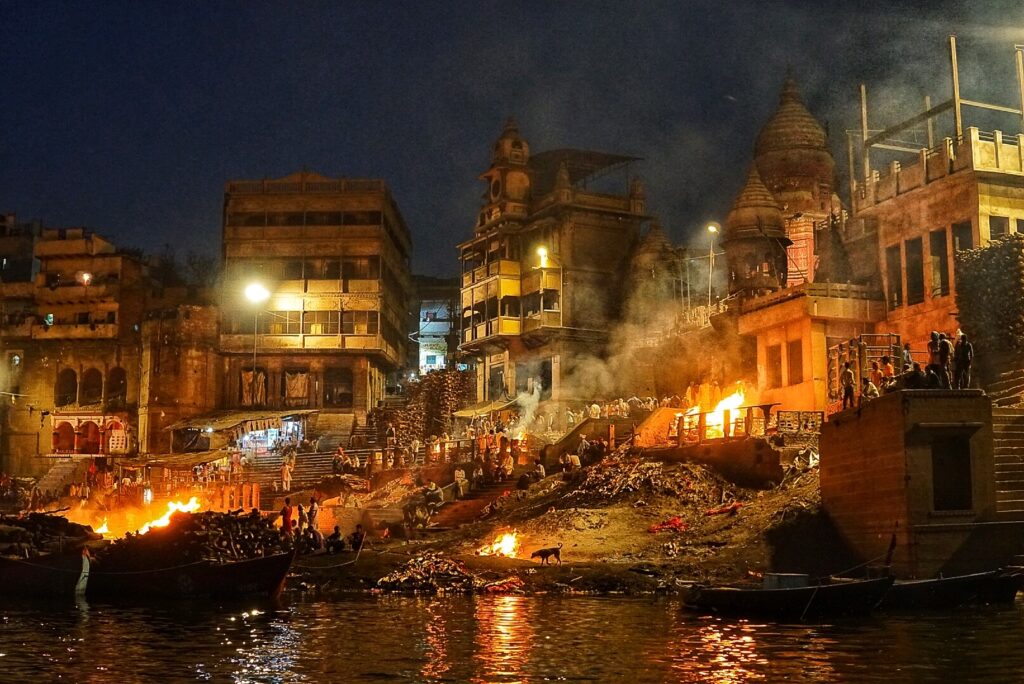
Manikarnika Ghat after dark, 28 February 2018. Available as a limited edition print.Gaurav
We had a guide called Gaurav, who decided within about ten minutes that my dad and I were his brothers and then never used our names again. Brother this, brother that, both of us, all day, all three days. Alongside the guiding he runs a hotel, and he seems to handle every part of it himself.
First he took us through the city, then through Holi two days later, which are completely different jobs. Without him I would not have understood half of what I was looking at, and that is the honest argument for hiring someone here. Varanasi gives you so much more if you try to understand it.
The galis
The next morning we went in on foot.
Varanasi is a city of alleys, the galis, and they are narrow in a way photographs flatten. Two people pass by turning sideways. Cows stand in them and you go around the cow. Shops open straight into them. Meanwhile the light comes down with layers.
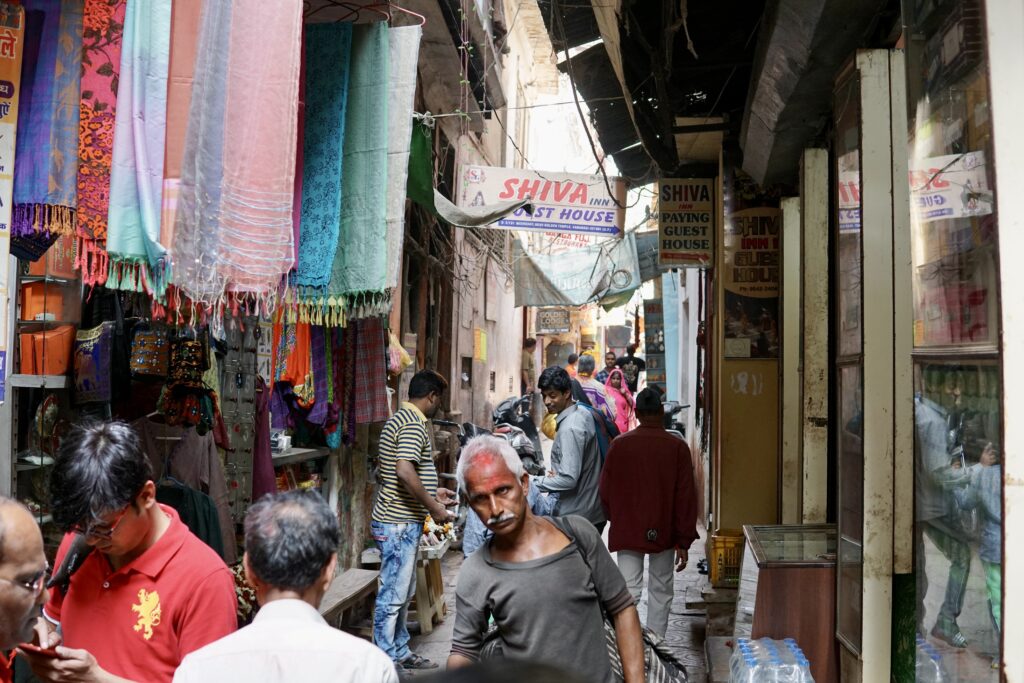
What I was not ready for was the traffic through them.
Bodies come through the galis on the way to the cremation ground. Four men carry each one on a bamboo frame at a fast walk, calling out ahead of them. Because the alley is too narrow to step aside properly, you press into a doorway and they pass close enough to touch. Then another one. Then another. It happens all day and all night, and nobody around you reacts, because for them nothing unusual is happening. That was the first thing that got me that day, the ordinariness of grief.
Manikarnika on foot
I had already photographed it from the river. Standing on it is a different thing entirely.
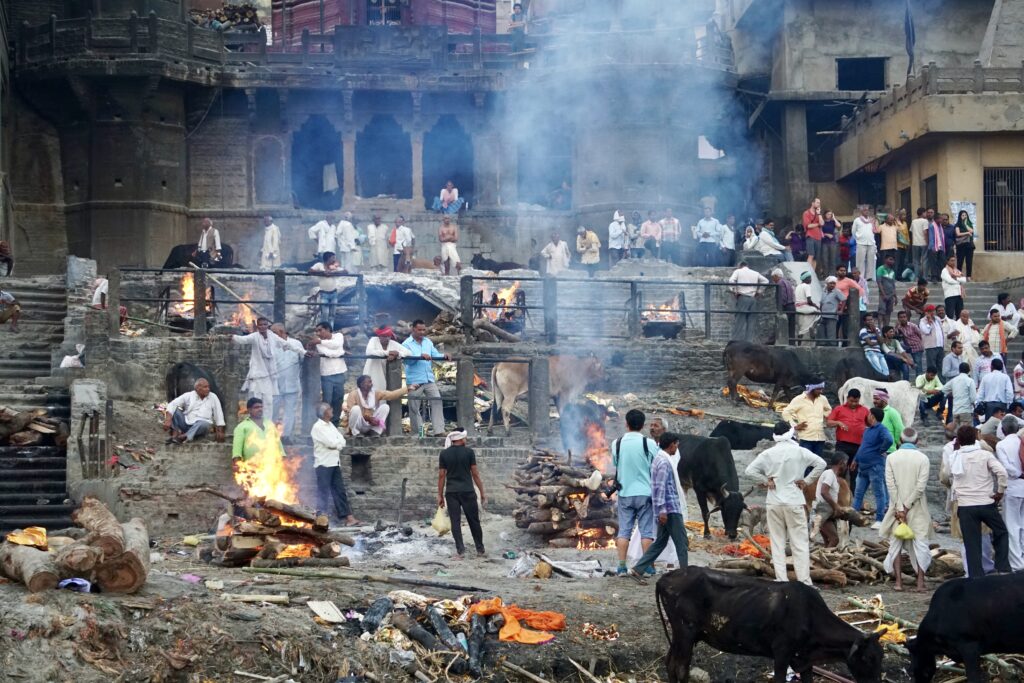
Manikarnika Ghat is the main cremation ground and it has burned without stopping for a very long time. Wood rises in stacks along the steps and up the walls behind. Fires at every stage, some just lit, some down to embers. Men working. Ash going into the river. Heat coming off all of it in a wall.
It is intense, and I want to be plain about that rather than dress it up, because I read a lot about Varanasi before I went and none of it prepared me. There is no viewing platform and no separation. You are standing in it.
The thing I have never been able to unsee is a dog walking off with a human bone in its mouth, carrying it past the woodpiles like it was any other day. Somehow it felt normal at the time. Now it feels surreal.
The Ganga Aarti
That evening we went to Dashashwamedh Ghat for the Ganga Aarti, which is a completely different event to the one I had spent the afternoon in front of, and people mix the two up constantly. The Aarti is a ceremony. Priests on raised platforms, lamps, fire moved in patterns, bells. The burning ghats are funerals. Both involve fire and the river, and that is where the resemblance ends.
It starts with a conch. One long note, and immediately you know something is coming.
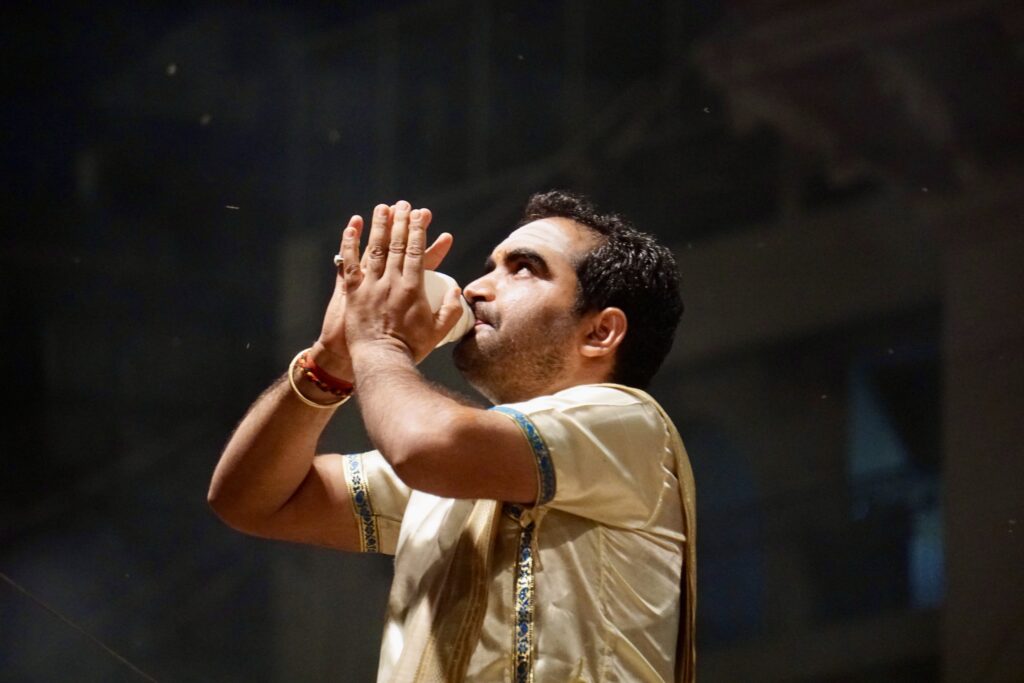
I had ended up standing directly in front of the guy with the conch, which is the loudest place you can possibly be and I would stand there again. What stayed with me afterwards was not the priests though. It was the crowd. Everyone was completely enchanted. And all of this on a regular Thursday, at a thing that happens every single night of the year.
What happened after I left
Modi laid the foundation stone for the Kashi Vishwanath Corridor on 8 March 2019, a year and a week after I walked those lanes. Meanwhile the demolition uncovered forty ancient temples inside those buildings, structures that houses and shops had swallowed over centuries, and those still stand.
The argument in India is genuinely contested, and I was there for two days, so I will not pretend to settle it. I will give you both halves instead. Pilgrims can now reach the temple straight from the river, where before they had to thread the galis to get there. The project also removed most of the neighbourhood that filled those galis, and it moved hundreds of people out of their homes.
Anyway, the reason I am writing this post at all is that I have a few frames of alleys that were about to stop existing. I knew while I stood there that the place was special, because I had never been anywhere that intense. What I did not know was how little time those lanes had left.
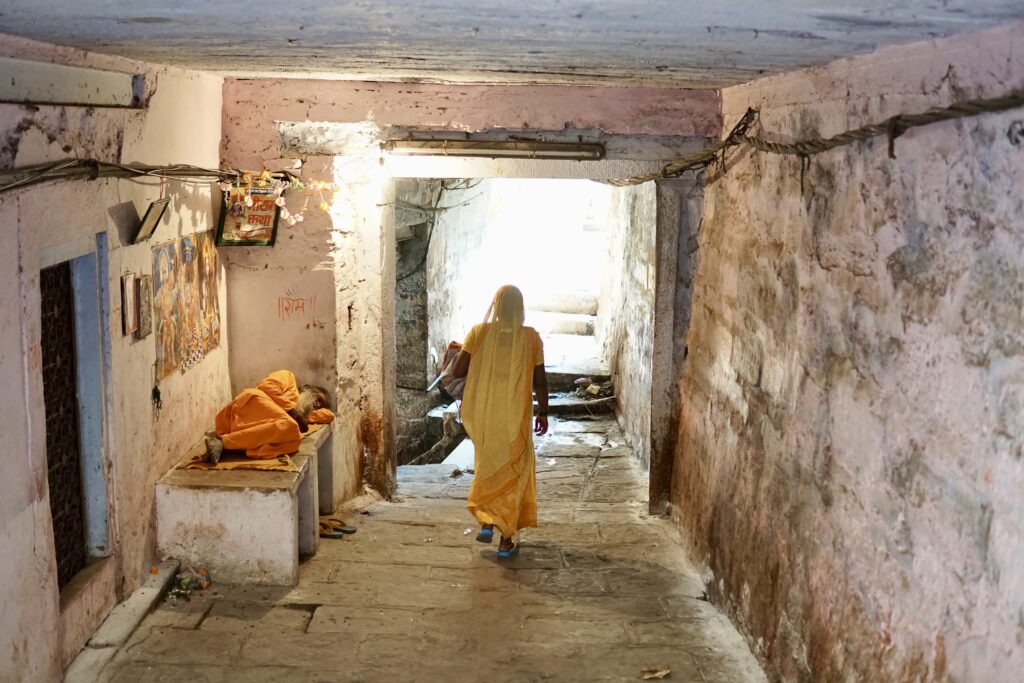
This alley may no longer exist. Photographed 1 March 2018, a year before the demolitions.Two days in the city. When we woke up the morning after the Aarti, it was time for us to celebrate Holi. Luckily, Gaurav also helped us through, but this is an a story in itself.
Know before you go
The short version: it is not a place you look at, it is a place you are standing in.
- Take the boat on your first evening, after dark. The fires are the only thing lighting the bank.
- Never point a camera at a pyre. And if someone offers to walk you upstairs for a better view in exchange for a donation to the wood fund, that is the oldest scam on the ghat.
- Get a local guide, ideally one who can arrange the boat and knows where to stand.
- The galis are not navigable by map. Getting lost is part of it, so keep walking.
- Early March gave us warm gold light instead of the haze I expected. Evening from the water is the one.
FAQ
They are the ghats where open-air cremations take place on the bank of the Ganges. Manikarnika is the main and largest one, and Harishchandra is the other. The families of the deceased carry their loved one down through the alleys of the old city. Once the family arrives at the ghat, the deceased gets cremated on wood pyres. The ashes go into the river. The fires run continuously, day and night and nothing is staged.
Two different things at two different ghats, and this is the most common mix-up in Varanasi. The Ganga Aarti is an evening ceremony at Dashashwamedh Ghat with priests, lamps, bells and music, performed nightly to a large crowd. The burning ghats are cremation grounds. I saw both on the same day, the cremations in the afternoon and the Aarti after dark, and they are nothing alike.
Not standing on the steps. Families are there, it is a funeral, and you will be told to put the camera away(you dont want someone photographing your nana’s funeral do you?). The one place it is reasonable is from a boat on the river, where you are at real distance and photographing the ghat rather than a pyre. That is where mine is from. The one that was made on land was when most of the funerals were over, and most people are unrecognisable.
It is intense and that is not a marketing word here. The bodies pass you in alleys narrow enough to touch them, the cremation ground has no barrier around it, and death is not kept out of sight anywhere. I found it overwhelming and I would still tell you to go. If you want an easy introduction to India, this is not it.
Substantially. Around three hundred buildings were demolished and roughly five acres cleared between 2019 and December 2021 to build the Kashi Vishwanath Corridor, a stone route about 400 metres long linking the temple to the river. The demolition uncovered forty older temples inside those buildings, and they still stand. If you saw the old lanes before 2019, then, what you saw is partly gone.
Three is a reasonable minimum. I had two in the city plus Holi, and the two were not enough.
Ja dit is fire hoorrr – literally